
Here’s How We Can Help Make the Mortgage Side Easier You find a house you…
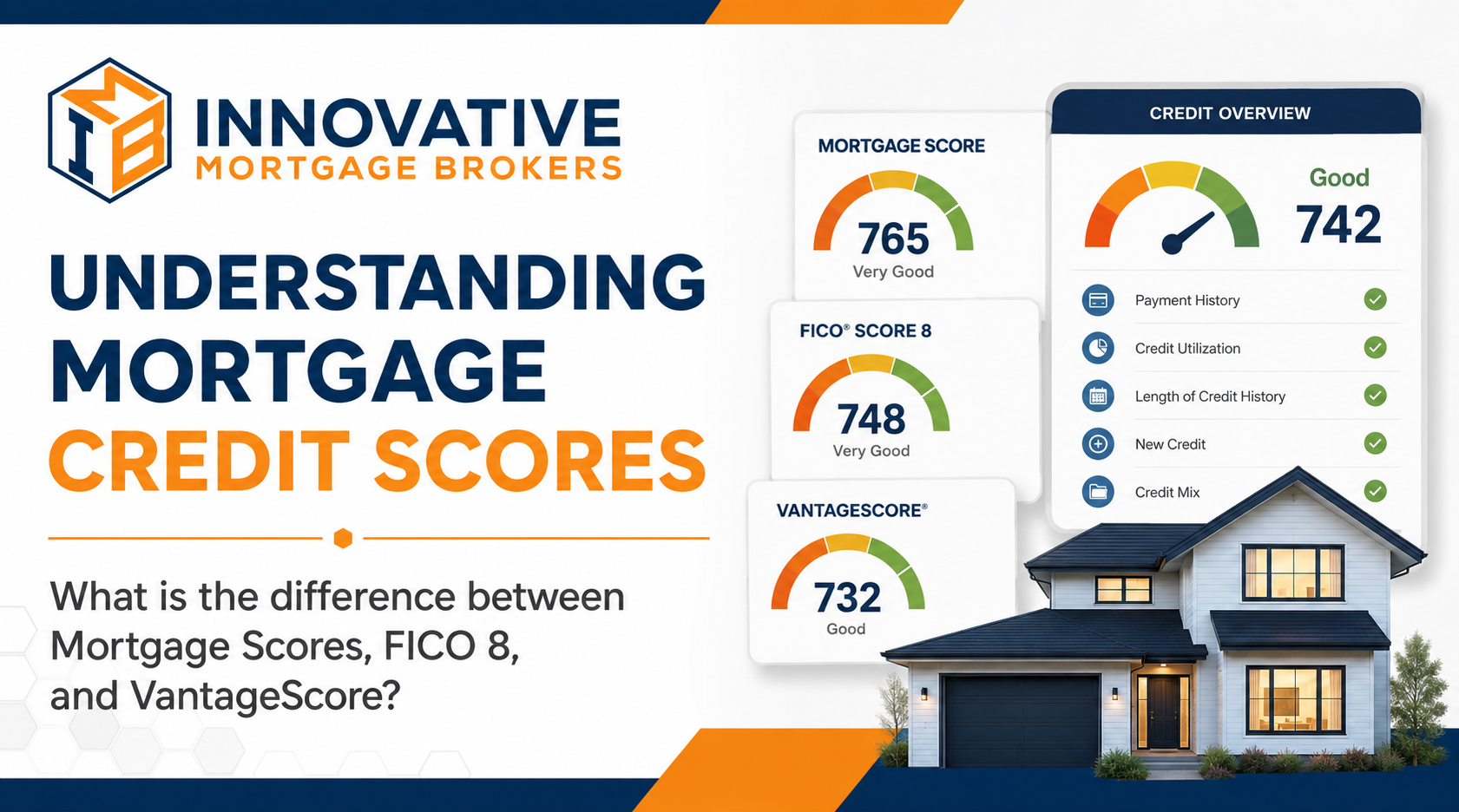
Mortgage Credit Score vs. FICO 8 vs. VantageScore: What’s the Difference?
Why Your Scores Can Be Different
One of the most confusing parts of the mortgage process is credit scoring.
A borrower may open a credit monitoring app and see a 720 credit score, only to apply for a mortgage and be told their qualifying score is 684.
Then they check another website and see 707.
Which score is correct?
Potentially, all of them.
The reason is simple: there is no single universal credit score.
Different lenders, industries, and credit-monitoring services may use different scoring models. Those models can look at the same credit report and produce different numbers.
For mortgage borrowers, this distinction matters because the score you see through a credit card app or consumer website may not be the same score your mortgage lender uses.
Below is a clear breakdown of the three terms borrowers encounter most often:
- Traditional mortgage credit scores
- FICO Score 8
- VantageScore
And in 2026, the mortgage industry is beginning to change significantly because newer scoring models are finally being introduced.
First: What Is a Credit Score?
A credit score is a numerical estimate of the risk that a consumer may fail to repay credit obligations as agreed.
Most commonly used consumer credit scores fall between 300 and 850, with higher scores generally representing lower predicted credit risk.
The score itself is calculated from information contained in a credit report, such as:
- Payment history
- Balances
- Credit utilization
- Age of accounts
- Number and types of accounts
- Recent credit inquiries
- Derogatory credit history
However, the formula used to interpret that information can differ substantially from one scoring model to another.
That is why two scores calculated from the same credit bureau data can still be different.
What Are “Mortgage Scores”?
When mortgage professionals talk about a borrower’s mortgage credit score, they have traditionally been referring to older versions of the FICO scoring model specifically used in mortgage lending.
For many years, the traditional mortgage industry relied primarily on:
- Experian: FICO Score 2
- TransUnion: FICO Score 4
- Equifax: FICO Score 5
These are often collectively called Classic FICO mortgage scores.
These models are older than FICO Score 8, but they remained deeply embedded in mortgage underwriting because Fannie Mae and Freddie Mac historically required them for loans they purchased or guaranteed.
That is why a borrower checking a modern consumer credit score could see a number significantly different from the score pulled during a mortgage application.
Why Do Mortgage Lenders Pull Three Scores?
Mortgage lenders commonly obtain a tri-merge credit report, meaning information from all three nationwide credit bureaus:
- Experian
- Equifax
- TransUnion
Because each bureau may contain slightly different information, the three scores may also differ.
For example:
Experian: 692
TransUnion: 708
Equifax: 701
Traditionally, a lender would use the middle score, which in this example would be:
701
For a joint application, mortgage underwriting has traditionally focused on the applicable representative score under the program’s rules, often resulting in the lower representative score between borrowers being important for qualification or pricing.
This is another reason borrowers sometimes become confused when looking at a single score from one credit bureau.
Your lender may be reviewing all three.
What Is FICO Score 8?
FICO Score 8 is a newer generation of the FICO model than the traditional mortgage scores.
It is one of the most widely used FICO models across consumer lending and is commonly used for:
- Credit cards
- Personal loans
- General credit decisions
- Consumer credit monitoring
According to myFICO, FICO Score 8 remains one of the most widely used general-purpose FICO scores among lenders.
But historically, it has not been the primary score used for most mortgage underwriting.
That surprises many borrowers.
Your credit card company may show you a FICO Score 8 of 735, but a traditional mortgage credit pull could produce:
FICO 2: 704
FICO 4: 716
FICO 5: 697
Your traditional mortgage qualifying score could therefore be much lower than the score you have been monitoring.
Is FICO Score 8 More Accurate Than a Mortgage Score?
That is not really the right way to look at it.
The models were designed at different times and for somewhat different purposes.
A score is not simply trying to tell you whether you are a “good” or “bad” borrower.
It is a statistical model designed to rank future credit risk.
Different versions can:
- Weight revolving balances differently
- Treat collections differently
- Evaluate inquiries differently
- React differently to recently opened accounts
- Place different emphasis on account history
- Respond differently to utilization
So a borrower can legitimately have several different FICO scores at the same time.
What Is VantageScore?
VantageScore is a competing credit-scoring system that was created by the three major credit reporting companies:
- Equifax
- Experian
- TransUnion
Like modern base FICO models, VantageScore 3.0 and 4.0 generally use a 300-to-850 range.
You may already have seen a VantageScore without realizing it.
Many free consumer credit-monitoring websites and apps provide a version of VantageScore rather than a FICO Score.
This is why the score you see through a free credit-monitoring service may not historically have matched the mortgage score your loan officer pulled.
VantageScore 3.0 vs. VantageScore 4.0
This distinction is important.
When someone says, “My VantageScore is 720,” the next question should be:
Which version?
VantageScore 3.0 is still commonly used in consumer-facing credit tools.
VantageScore 4.0 is the newer model that has become particularly important for mortgage lending.
VantageScore says the 4.0 model uses:
- Trended credit data
- More advanced modeling
- Rent data when reported
- Utility and telecom data when reported
- Broader scoring capabilities for consumers with limited traditional credit histories
Trended data means the model can evaluate how credit behavior has changed over time instead of looking only at a snapshot today.
What Is Trended Credit Data?
This is an important difference between traditional mortgage scores and newer models.
Imagine two borrowers both have a $5,000 credit card balance today.
Borrower A:
- Had a $9,000 balance six months ago
- Has steadily paid it down to $5,000
Borrower B:
- Had a $500 balance six months ago
- Has steadily increased it to $5,000
A traditional point-in-time model may see two consumers with the same current balance.
A model using trended data can potentially recognize that their financial behavior is moving in opposite directions.
VantageScore 4.0 specifically incorporates this type of historical balance and payment trajectory into its scoring methodology.
The Mortgage Industry Changed in 2026
This is where this topic becomes especially interesting.
For decades, traditional Classic FICO models dominated conventional mortgage lending.
That began changing in 2026.
The Federal Housing Finance Agency announced that Fannie Mae and Freddie Mac are moving into a framework that permits additional approved credit-scoring models.
The approved models now include:
- Classic FICO
- VantageScore 4.0
- FICO Score 10T
Fannie Mae announced in April 2026 that VantageScore 4.0 may be used immediately under its updated framework, while FICO Score 10T is planned for future use. Freddie Mac announced a similar expansion.
FHFA described this as the beginning of a more competitive mortgage credit-scoring system.
Does That Mean Every Mortgage Lender Now Uses VantageScore?
No.
This is an important distinction.
Permitted does not mean universally adopted.
Fannie Mae and Freddie Mac have created a path for approved lenders to use VantageScore 4.0, but mortgage lenders have to update:
- Credit-reporting systems
- Loan origination systems
- Underwriting workflows
- Pricing engines
- Investor procedures
- Compliance systems
Freddie Mac specifically describes its VantageScore 4.0 implementation as being available to approved sellers as part of a controlled rollout.
So depending on the lender, a borrower may still be evaluated using traditional Classic FICO scores.
This is likely to evolve over time.
What Is FICO 10T?
FICO Score 10T is another newer model that is also entering the mortgage industry.
The T stands for trended data.
Like VantageScore 4.0, FICO 10T can evaluate changes in a consumer’s credit behavior over time rather than relying entirely on a point-in-time snapshot.
FHFA has approved FICO 10T as part of the mortgage credit-score modernization process, although implementation is occurring separately from the immediate VantageScore 4.0 rollout.
This means mortgage lending is moving away from a world where one set of decades-old scoring models controlled nearly every conventional mortgage decision.
Mortgage Score vs. FICO 8 vs. VantageScore: Simple Comparison
|
Score |
Common Use |
Range |
Traditionally Used for Mortgages? |
| Classic Mortgage FICO | Mortgage lending | 300-850 | Yes |
| FICO Score 8 | Credit cards, personal lending, general credit | 300-850 | Generally not the traditional mortgage score |
| VantageScore 3.0 | Consumer monitoring and various lenders | 300-850 | Historically no |
| VantageScore 4.0 | Modern consumer lending and now eligible mortgage use | 300-850 | Yes, under newer mortgage rules |
| FICO 10T | Modern credit-risk assessment | 300-850 | Approved for mortgage modernization |
The important point is:
A 700 is not necessarily the same 700 across every model.
Why Can My Mortgage Score Be 40 Points Lower Than Credit Karma?
This is one of the most common questions mortgage professionals hear.
A service such as Credit Karma may provide a VantageScore, while your lender may historically have pulled Classic FICO mortgage scores.
Different models.
Different formulas.
Different results.
The difference can sometimes be just a few points.
Other times it may be:
- 20 points
- 30 points
- 50 points
- Occasionally even more
That does not necessarily mean one company has incorrect information.
It can simply mean they are showing different scoring models.
Why Can My Scores Differ Between Experian, Equifax, and TransUnion?
Even when the same scoring model is used, the underlying bureau data can differ.
For example, a creditor may report an account to:
- Experian and Equifax
- But not TransUnion
Or a credit card balance may update on one bureau several days before another.
Other differences can include:
- Collections
- Authorized-user accounts
- Credit limits
- Account dates
- Hard inquiries
- Payment history
Because the scoring formula uses the data contained in each bureau’s report, different data can produce different scores.
Which Score Should a Homebuyer Pay Attention To?
If you are casually monitoring your credit, a consumer credit score is still useful.
It can help you identify:
- General trends
- Major changes
- High balances
- New accounts
- Potential credit-report problems
But if you are preparing to buy a home, the score that matters is the score model the mortgage lender will actually use for your loan.
That is why someone thinking about purchasing within the next several months should not automatically assume the score displayed by a free consumer app will determine their mortgage eligibility or pricing.
Why Credit Score Differences Can Cost Real Money
Credit scores can affect more than approval.
Depending on the mortgage program, they may influence:
- Interest rate
- Discount points
- Mortgage insurance
- Loan-level pricing adjustments
- Available loan programs
- Down-payment requirements
- Lender eligibility
Imagine two borrowers with identical:
- Income
- Down payment
- Loan amount
- Property
- Debt-to-income ratio
But one has a qualifying score of 760 while the other has 680.
Their mortgage pricing can be materially different.
This is why it is worth understanding the mortgage-specific score before making financial decisions based on the score displayed in an app.
Can Paying Off Credit Cards Improve a Mortgage Score?
Often, yes.
Credit card utilization can have a meaningful impact on many credit-scoring models.
But there is an important detail:
Paying the card is not enough if the new balance has not yet been reported to the credit bureau.
Credit scores generally calculate based on the balance appearing on the credit report at the time the score is generated.
For example:
Your card shows:
$8,000 balance / $10,000 limit
You pay it down to:
$1,000
That may help your score substantially.
But until the card issuer reports the new $1,000 balance, the scoring model may still see $8,000.
In certain mortgage situations, lenders may be able to use a rapid rescore process after supporting documentation is provided to update certain credit-report information more quickly.
Should You Close Credit Cards Before Applying for a Mortgage?
Usually, this should be approached carefully.
Closing a credit card can reduce your total available revolving credit, potentially increasing your utilization percentage.
For example:
Before closing a card:
Balances: $3,000
Total limits: $30,000
Utilization:
10%
If you close an unused card with a $15,000 limit:
Balances: $3,000
Remaining limits: $15,000
Utilization becomes:
20%
Even though you did not borrow another dollar.
That is why borrowers should generally avoid making major credit changes immediately before applying for a mortgage without discussing the impact first.
Should You Pay Off Every Credit Card Before Buying?
Not necessarily.
You may have $20,000 available and think:
“I’ll pay off every debt before applying.”
But using all $20,000 may leave you short on:
- Down payment
- Closing costs
- Reserves
- Moving expenses
- Emergency savings
Sometimes paying down a specific card strategically provides a meaningful score improvement while preserving cash.
Other times, eliminating a monthly payment may improve the debt-to-income ratio more than improving the score.
Mortgage planning should consider all of these factors together.
What Should You Do Before Applying for a Mortgage?
A few months before purchasing, consider:
- Pay every obligation on time
- Keep revolving balances low
- Avoid opening unnecessary accounts
- Avoid closing established accounts without a reason
- Review all three credit reports for errors
- Dispute inaccurate information well before applying
- Avoid large credit purchases
- Ask your mortgage professional before making major credit changes
Most importantly, do not obsess over every daily score fluctuation.
Credit scores are one part of mortgage qualification.
Income, assets, debts, property type, occupancy, down payment, and loan program all matter too.
Frequently Asked Questions About Mortgage Credit Scores
Why is my mortgage credit score different from my FICO Score 8?
Mortgage lenders have traditionally used older Classic FICO models such as FICO 2, 4, and 5, while many consumer and non-mortgage lenders use FICO Score 8. Different scoring formulas can produce different scores from the same credit report.
Is Credit Karma showing my mortgage score?
Usually not. Credit Karma commonly provides VantageScore rather than the traditional Classic FICO mortgage scores. The score is still useful for monitoring credit trends, but it may not match the score used for your mortgage.
Which FICO score is used for mortgages?
Historically, mortgage lenders commonly used FICO Score 2 from Experian, FICO Score 4 from TransUnion, and FICO Score 5 from Equifax. Mortgage credit scoring is now changing as VantageScore 4.0 and FICO 10T enter the market.
Is VantageScore now used for mortgages?
Yes, VantageScore 4.0 is now an approved model within the updated Fannie Mae and Freddie Mac mortgage framework. However, adoption depends on the lender and implementation remains in transition.
Is a VantageScore the same as a FICO Score?
No. Both generally use a 300-to-850 scale, but they are separate models developed by different organizations and may calculate credit risk differently.
Is a 700 VantageScore equivalent to a 700 FICO score?
Not necessarily. Although the numerical ranges are similar, the models are different. A 700 on one model should not automatically be interpreted as equivalent to a 700 on another.
Why do I have three different mortgage scores?
Experian, Equifax, and TransUnion may contain slightly different information. Even when similar scoring models are applied, differences in the underlying credit reports can result in different scores.
Can a mortgage broker tell me how to improve my mortgage score?
A mortgage professional can review the credit report and identify items that may potentially affect qualification, pricing, or debt-to-income calculations. However, credit-score changes cannot be guaranteed because the scoring formulas are proprietary.
The Bottom Line
Your credit score is not one permanent number.
You may have:
- A FICO Score 8
- Several mortgage FICO scores
- A VantageScore
- A FICO Auto Score
- A FICO Bankcard Score
- Newer scores such as FICO 10T
And they can all be different.
For someone preparing to purchase or refinance a home, the key question is not:
“What is my credit score?”
It is:
“What credit score will be used for my mortgage?”
That distinction can affect qualification, mortgage insurance, pricing, and your overall financing strategy.
At Innovative Mortgage Brokers, we can review your mortgage credit profile and help determine which loan programs may fit your situation.
If your consumer credit app shows one score and your mortgage score turns out to be different, do not immediately assume something is wrong.
There may simply be a different scoring model behind the number.
Schedule a mortgage consultation to review your options.

Related Posts