How buying down your rate works, when it pays, and when to skip it Paying…
Iran Conflict and Mortgage Rates
Mortgage rate volatility, oil shocks, and why execution matters more than quotes
When a war flares up in the Middle East, most people think “oil” and “gas prices.” Mortgage rates usually are not the first thing that comes to mind.
But the bond market cares a lot about geopolitical risk, and mortgage rates are built on top of the bond market. So when headlines get intense, mortgage rates can move quickly, sometimes in ways that feel confusing.
Where the market stood on Friday, February 27, 2026 (the last trading day)
Mortgage rates and bond yields move all day, and different sources track them slightly differently. But the big picture on Friday 2/27 was:
- Mortgage rate pricing was hovering right around the 6% range for many top-tier 30-year fixed scenarios.
- The 10-year Treasury moved lower and ended the day just under 4% (roughly in the high 3.9s).
Those two numbers matter because, over time, mortgage rates tend to move in the same direction as longer-term Treasury yields. Not perfectly, not instantly, but directionally.
So why would a conflict with Iran change these numbers? Let’s walk through the “why” first, then the “what to do.”
The simple truth: mortgage rates are emotional before they’re logical
In calm markets, rates mostly respond to economic data: inflation, jobs, growth, and what the Federal Reserve might do next.
In tense markets, rates can respond to emotion: fear, uncertainty, and investors repositioning fast.
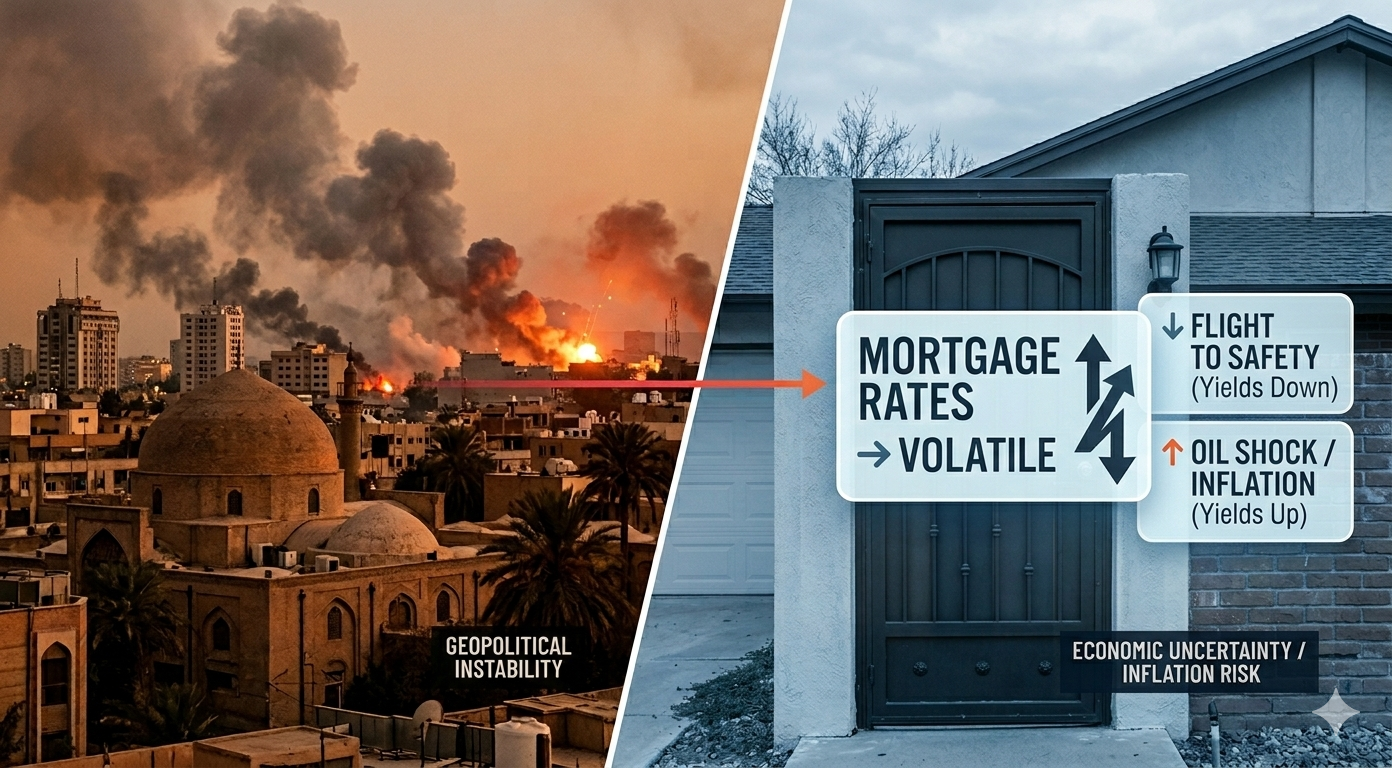
A conflict involving Iran tends to hit markets through two main channels:
- Oil and inflation worries
- A flight to safety into U.S. bonds
These two forces can push in opposite directions, which is why rate moves can feel jumpy.
Channel #1: Oil risk can push inflation higher (and that can push rates higher)
Iran sits in a region that is central to global energy supply routes. When the market believes shipping could be disrupted, oil prices can jump quickly.
Why oil matters to mortgage rates:
Oil is not just “gas for your car.” Oil affects shipping, production, travel, deliveries, and the cost of running just about everything. If oil spikes and stays elevated, everyday prices can creep up again.
That feeds into inflation expectations.
And inflation expectations are a big deal in the bond market. If investors believe inflation will run hotter, they often demand higher yields to lend money for long periods of time. Higher yields usually mean higher mortgage rates.
A simple example
If the market starts thinking, “Energy prices will keep inflation stubborn,” investors may say, “If I’m going to lend for 10 years, I want a higher return.” That pushes yields up, and mortgage rates can follow.
Channel #2: Fear can push investors into “safe” assets (and that can pull rates down)
At the same time, wars can trigger a “risk-off” move. That’s just Wall Street language for:
“I don’t want risky investments right now. I want safety.”
When investors want safety, they often buy U.S. Treasury bonds. When demand for Treasuries rises, Treasury yields fall.
That can be good news for mortgage rates, at least temporarily.
So here’s the tug-of-war:
- Oil shock / inflation pressure can push rates up
- Flight to safety can pull rates down
Which one “wins” depends on how severe and how long markets think the conflict will last, and whether oil disruption becomes real and sustained or just feared.
The part most people miss: mortgage rates do not move one-for-one with bonds
Even if the 10-year Treasury drops, mortgage rates might not drop as much. Sometimes they barely budge.
Why? Because mortgage rates are priced off mortgage-backed securities (think of them as bundles of home loans that investors buy). When markets get volatile, investors often demand extra cushion for risk and uncertainty. That extra cushion shows up as a wider “gap” between Treasury yields and mortgage rates.
In normal terms:
- Treasuries are the “clean” benchmark.
- Mortgages have more moving parts: servicing costs, prepayment risk, market liquidity, and lender hedging costs.
- When uncertainty rises, the mortgage market can get more cautious.
That’s why you can see a day where the bond market improves but mortgage pricing improves only a little, or takes longer to show up.
What this means for homebuyers in a heating local market
If you’re shopping for a home right now, the Iran conflict matters, but maybe not in the way people expect.
Yes, rates can move.
But the bigger risk we’re seeing in real life is this: buyers losing control of the process because the financing wasn’t built correctly from the start.
In competitive markets, timing matters. Sellers want clean offers with dependable financing. If your financing gets shaky midstream, you can lose the house, lose time, and potentially lose money.
Here are the most common ways deals break down:
1) The pre-approval was quick, not thorough – A quick pre-approval might look fine on paper, but if the income, assets, credit details, property type, or documentation needs were not truly reviewed upfront, problems can show up later in underwriting. And when they show up late, you’re stuck with fewer options and less time.
2) The terms change midway through – This can happen for many reasons:
- A lender underestimates costs or misquotes the scenario
- The borrower’s file was not structured correctly
- The lock strategy was unclear
- A guideline detail was missed early (condo rules, appraisal conditions, income calculation, overtime or bonus averaging, self-employed documentation, etc.)
When terms change late, it is stressful and it can create trust issues between buyer and seller, especially when a closing date is approaching.
3) The timeline gets squeezed – In a volatile rate market, some lenders get overwhelmed. Underwriting turn times slow down. Conditions stack up. Appraisals get delayed. Communication gaps grow. That is how a normal deal becomes a mess.
If you’re already under contract: you may still have options
If you’re under contract and something feels off with your current lender, the key question is not “Can I switch?” but:
“Can I switch and still hit my closing date?”
Sometimes the answer is yes, depending on:
- how far you are from closing
- whether the appraisal is done
- whether title is in motion
- how complete your documentation is
- the complexity of your income and property type
- whether there are repairs, condo approvals, or special conditions
The biggest mistake is waiting until the last week to address a problem. Switching late is harder. Switching earlier can be very manageable.
What homeowners should watch (refinance or future planning)
If you’re a homeowner, you might be thinking: “Does this mean I should refinance now?”
Here’s the honest answer: it depends on your goals. But the Iran conflict mainly changes one thing for homeowners:
Expect more rate volatility, not a straight line
In volatile periods, rates can bounce. One week you might see improvement, the next week the market reacts to a new headline and pricing worsens.
If you are considering a refinance, the best approach is usually:
- know your target (rate, payment, term change, cash-out amount)
- know your break-even point (how long it takes savings to cover costs)
- be ready to act when the market gives you a window
Refinancing is less about predicting the perfect bottom and more about executing a smart move when the math works.
Practical steps you can take right now
Here’s what we recommend in a headline-driven market like this.
If you’re a buyer (not yet under contract)
- Make sure your pre-approval is based on a real review of income, assets, and credit
- Ask what documentation will be required upfront so you’re not surprised later
- Have a clear strategy for rate locks and timing
- Work with someone who will communicate fast, including nights and weekends when needed, because offers and problems do not wait for business hours
If you’re under contract
- Get clarity today on your timeline: appraisal, underwriting status, outstanding conditions
- If anything feels shaky, get a second opinion early
- If switching is possible, do it before the final stretch so you protect your closing date
If you’re a homeowner
- Decide what success means (lower payment, shorter term, cash-out, or removing mortgage insurance)
- Track rates weekly and be ready when the math is in your favor
- Do not let volatility push you into panic moves. Use a plan.
Bottom line
A conflict involving Iran can affect mortgage rates because it impacts oil, inflation expectations, and investor behavior in the bond market. The result is a market that can swing based on headlines, and that can show up as quick rate changes.
But for most buyers, the bigger risk is not a small rate move. It’s a deal that becomes unstable because the financing was not structured correctly from the start, or because communication and execution break down when the timeline tightens.
Buying a home is stressful enough. You should not also be worrying about whether the loan will actually make it to the closing table on time.
If you’re buying, under contract, or thinking about refinancing, the smartest next step is a quick check-in to make sure your plan is solid and your timeline is protected.

Related Posts