Understand how VA residual income works, what the guidelines are, and how it affects your…
Pennsylvania VA Loans: Benefits, Requirements, and Local Guidance
VA Mortgages in Pennsylvania: A Complete Guide for Veterans and Military Homebuyers
For eligible Veterans, active-duty service members, and qualifying surviving spouses, a VA mortgage can be one of the most valuable paths to homeownership in Pennsylvania.
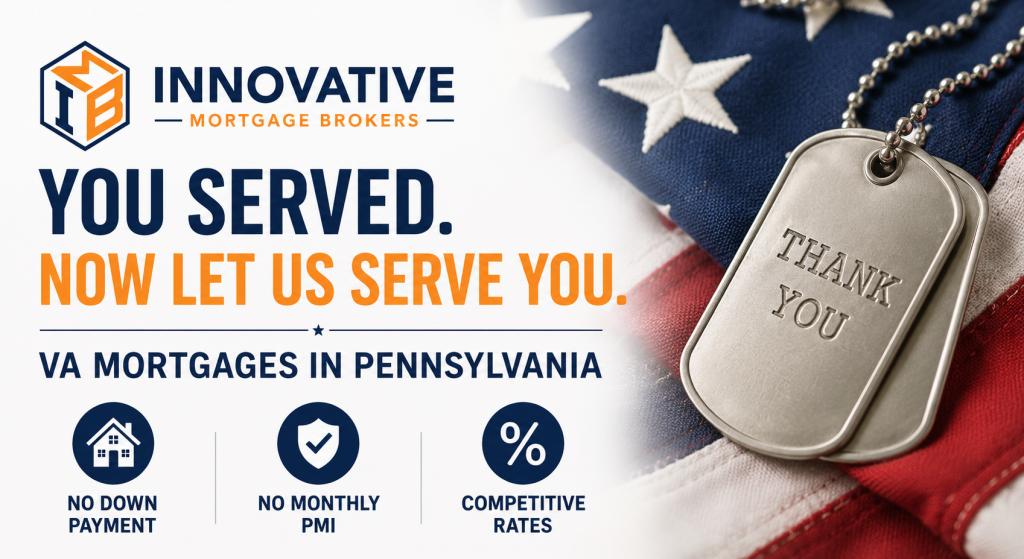
VA loans may allow qualified borrowers to purchase a primary residence with no down payment, no monthly private mortgage insurance, and competitive mortgage rates. However, getting approved still requires careful planning. Your income, credit, debts, residual income, military eligibility, property condition, and overall loan structure all matter.
At Innovative Mortgage Brokers, we help eligible VA borrowers throughout Pennsylvania, including Philadelphia, Bucks County, Montgomery County, and Chester County, understand their options and move through the mortgage process with confidence.
What Is a VA Mortgage?
A VA mortgage is a home loan made by a private lender and partially guaranteed by the U.S. Department of Veterans Affairs.
The VA does not usually lend the money directly. Instead, the VA guaranty helps reduce the lender’s risk, allowing approved lenders to offer eligible borrowers favorable financing terms.
A VA mortgage may be used to:
- Purchase an eligible primary residence
- Purchase a one-to-four-unit property, provided the borrower occupies one unit
- Purchase an eligible condominium
- Build a qualifying primary residence
- Refinance an existing mortgage
- Refinance an existing VA loan through a VA Interest Rate Reduction Refinance Loan, commonly called an IRRRL
- Access available home equity through an eligible VA cash-out refinance
Learn more about our VA home loan options in Pennsylvania.
Major Benefits of VA Mortgages in Pennsylvania
No Down Payment May Be Required
Many eligible VA borrowers can finance 100% of a home’s purchase price without making a down payment.
This can make homeownership more accessible for Veterans and service members who have reliable income but do not want to use a large portion of their savings for a down payment.
No down payment does not necessarily mean no money is needed at closing. Buyers may still have closing costs, prepaid property taxes, homeowners insurance, title charges, and other expenses. Seller assistance, lender credits, and other strategies may help reduce the amount needed, depending on the transaction.
No Monthly Private Mortgage Insurance
Conventional buyers who make a smaller down payment often pay private mortgage insurance, commonly known as PMI.
VA mortgages do not require monthly PMI. Eliminating monthly mortgage insurance may reduce the monthly payment compared with other low-down-payment financing options.
Competitive Mortgage Rates
VA loans frequently offer competitive rates because part of the loan is guaranteed by the Department of Veterans Affairs.
The rate available to an individual borrower will still depend on factors such as:
- Credit history
- Loan amount
- Property type
- Occupancy
- Interest-rate lock period
- Discount points or lender credits
- Current market conditions
- The lender selected for the loan
As a mortgage broker, we can compare VA mortgage options from multiple lenders instead of limiting you to the products offered by a single bank.
Flexible Qualification Guidelines
VA financing may provide more flexibility than some conventional loan programs. However, a VA loan is not an automatic approval.
The lender must still confirm that the borrower has acceptable credit, stable qualifying income, sufficient residual income, and the ability to make the proposed mortgage payment.
Who May Qualify for a VA Loan?
VA loan eligibility is generally based on the borrower’s military service history and duty status. Potentially eligible borrowers may include:
- Veterans
- Active-duty service members
- Certain members of the National Guard
- Certain members of the Reserves
- Some surviving spouses
The specific service requirements vary based on when and how the borrower served.
A Certificate of Eligibility, known as a COE, confirms whether the borrower has eligible VA home loan entitlement. In many cases, a lender or mortgage broker can request the COE electronically.
A COE confirms eligibility for the VA benefit, but it does not guarantee mortgage approval. The borrower must also meet the lender’s credit, income, asset, occupancy, and underwriting requirements.
Does the VA Have a Minimum Credit Score?
The Department of Veterans Affairs does not establish one universal minimum credit score for every VA mortgage.
However, individual lenders may establish their own minimum credit score requirements. These additional lender requirements are commonly called lender overlays.
This is one reason working with a mortgage broker may be helpful. A borrower who does not meet one lender’s credit requirements may potentially fit another lender’s guidelines.
Credit score is only one part of the decision. Underwriters may also evaluate:
- Recent payment history
- Late mortgage or rent payments
- Collections and charged-off accounts
- Bankruptcy or foreclosure history
- Current debts
- Debt-to-income ratio
- Residual income
- Employment and income stability
- Available funds and reserves
A lower credit score does not necessarily prevent approval, but the full credit profile must support the borrower’s ability and willingness to repay the loan.
VA Residual Income Requirements
VA underwriting places significant emphasis on residual income.
Residual income is the money remaining each month after accounting for the proposed housing expense, installment debts, revolving debts, taxes, and certain household obligations.
The required amount depends on several factors, including:
- Household size
- Loan amount
- Property location
- The region in which the property is located
Pennsylvania is part of the Northeast region for VA residual income calculations.
Residual income can be especially important when a borrower’s debt-to-income ratio is higher. A strong residual-income calculation may help demonstrate that the household will still have sufficient funds available after paying its recurring obligations.
Read our detailed guide to VA residual income requirements for borrowers in Pennsylvania.
What Is the VA Funding Fee?
Most VA borrowers pay a one-time VA funding fee. This fee helps support the VA home loan program.
The amount can vary based on:
- Whether it is the borrower’s first or subsequent use of VA financing
- The type of VA loan
- The amount of the down payment
- Whether the borrower qualifies for an exemption
The funding fee can often be financed into the mortgage instead of being paid in cash at closing.
Certain borrowers may be exempt from the VA funding fee, including some Veterans receiving qualifying service-connected disability compensation and certain eligible surviving spouses.
Because funding-fee status can affect the loan amount and closing figures, it should be confirmed early in the process.
VA Mortgages in Philadelphia
A VA loan can be used to purchase an eligible primary residence throughout Philadelphia, from a rowhome in Northeast Philadelphia to a condominium in Center City or a multifamily property in another part of the city.
Philadelphia transactions can have details that require careful review, including:
- City real estate taxes
- Transfer taxes
- Condominium eligibility
- Property condition
- Mixed-use characteristics
- Multi-unit occupancy requirements
- Tax abatements
- Homeowners insurance
- Repairs identified during the appraisal
For a two-to-four-unit property, the Veteran must generally occupy one unit as a primary residence. The property must also meet applicable VA and lender requirements.
A careful preapproval should account for the property taxes, insurance, debts, income, and estimated payment before the buyer makes an offer.
Explore additional information about our Philadelphia mortgage services.
VA Mortgages in Bucks County
Bucks County includes a wide range of housing markets, from Levittown and Bristol in Lower Bucks to Newtown, Yardley, Doylestown, Warminster, Richboro, and communities throughout Central and Upper Bucks.
A VA borrower purchasing in Bucks County should pay close attention to property taxes. Taxes can vary considerably between municipalities and school districts, even when two homes have similar purchase prices.
Property type and condition also matter. Bucks County includes newer developments, older homes, condominiums, historic properties, homes with private wells, and properties with septic systems. Each may require different documentation or appraisal considerations.
In a competitive market, a strong VA preapproval can make an important difference. We review the borrower’s documents upfront, clearly communicate with the buyer and agent, and can speak with the listing agent when appropriate to explain the strength of the financing.
Learn more about working with a Bucks County mortgage broker.
VA Mortgages in Montgomery County
Montgomery County offers a diverse selection of homes in communities such as Abington, Willow Grove, Jenkintown, Blue Bell, Lansdale, Hatboro, King of Prussia, Conshohocken, Norristown, and surrounding areas.
Home prices, real estate taxes, homeowners association fees, and insurance costs can vary substantially throughout the county. These expenses affect the total monthly payment and the amount a borrower may qualify to purchase.
For example, two homes with the same purchase price can produce very different monthly payments if one has higher property taxes or a homeowners association fee.
Before making an offer, a VA buyer should have an updated payment estimate based on the actual property whenever possible. This is more reliable than relying only on the maximum purchase price shown on an initial preapproval.
Learn more about our Montgomery County mortgage options.
VA Mortgages in Chester County
Eligible Veterans and service members may use VA financing to purchase a primary residence throughout Chester County, including West Chester, Exton, Downingtown, Coatesville, Phoenixville, Malvern, Kennett Square, Oxford, and nearby communities.
Chester County properties can present several considerations:
- Higher purchase prices in some communities
- Property tax differences by school district
- Larger lots
- Private roads
- Shared driveways
- Private wells
- Septic systems
- New construction
- Homes with acreage
- Homeowners associations
These features do not automatically make a property ineligible for VA financing. They may, however, require additional documentation, appraisal review, inspections, agreements, or lender approval.
Borrowers should identify unusual property features early. Waiting until after the appraisal or underwriting review can create avoidable delays.
For statewide information, visit our Pennsylvania mortgage broker service page.
VA Property and Appraisal Requirements
A VA appraisal has two primary purposes:
- To provide an opinion of the property’s reasonable market value
- To evaluate whether the property appears to meet the VA’s Minimum Property Requirements
The VA appraisal is not the same as a complete home inspection. Buyers should still consider hiring a qualified home inspector to evaluate the property’s systems and condition.
Potential appraisal concerns may include:
- Peeling or defective paint in certain older homes
- Active roof leaks
- Missing handrails in potentially hazardous areas
- Unsafe electrical conditions
- Broken windows
- Inadequate heating
- Water intrusion
- Structural concerns
- Inadequate access
- Health or safety hazards
- Problems with private wells or septic systems
Not every cosmetic issue must be repaired. The focus is generally on safety, sanitation, structural soundness, and the property’s suitability as a residence.
Can a Seller Reject a VA Offer?
A seller can choose among the offers received, subject to applicable fair-housing and other laws. However, many concerns about VA financing are based on outdated information or misunderstandings.
A VA buyer can still present a strong offer when the file is properly prepared.
Helpful steps may include:
- Obtaining a fully reviewed preapproval
- Providing income and asset documents before making an offer
- Confirming the Certificate of Eligibility
- Reviewing residual income
- Using a realistic closing timeline
- Working with an agent who understands VA financing
- Having the loan officer communicate with the listing agent
- Avoiding last-minute lender changes
The financing program is only one part of an offer. Preparation, communication, contract terms, and confidence in the borrower’s approval also matter.
Can You Purchase a Multifamily Property With a VA Loan?
VA financing may be used to purchase an eligible property with up to four residential units, provided the Veteran occupies one unit as a primary residence.
Rental income from the other units may potentially help the borrower qualify, subject to VA and lender requirements. The lender may consider the borrower’s experience, available reserves, appraisal rents, and other factors.
A multi-unit property can provide an opportunity to live in one unit while receiving rental income from the others. However, the qualification and property review are typically more detailed than for a single-family home.
VA Refinancing Options in Pennsylvania
VA borrowers may also have refinancing options.
VA Interest Rate Reduction Refinance Loan
A VA IRRRL may allow an eligible homeowner with an existing VA mortgage to refinance into a new VA loan.
An IRRRL is generally used to improve the borrower’s loan terms, such as reducing the interest rate or changing an adjustable-rate mortgage into a fixed-rate mortgage. The transaction must meet applicable VA seasoning, recoupment, and net-tangible-benefit requirements.
VA Cash-Out Refinance
A VA cash-out refinance may allow an eligible borrower to:
- Refinance an existing VA loan
- Refinance certain non-VA mortgages into a VA loan
- Access available equity
- Change the loan’s interest rate or term
Approval depends on the borrower’s eligibility, income, credit, property value, equity position, and lender requirements.
Homeowners considering a refinance should compare the new payment, closing costs, interest rate, term, and long-term financial impact rather than focusing only on the new rate.
How to Prepare for a VA Mortgage Preapproval
A strong preapproval involves more than completing an online form.
You may be asked to provide:
- Government-issued identification
- Recent pay stubs
- W-2 forms
- Recent bank or asset statements
- Employment information
- Documentation of military service
- Certificate of Eligibility
- Disability award information, when applicable
- Current mortgage statements for properties owned
- Homeowners insurance and property tax information
- Divorce, child-support, or alimony documents, when applicable
- Explanations or documentation for significant credit issues
The specific documents depend on your employment, income, assets, credit, and property ownership.
Reviewing these items before you begin shopping can help uncover issues early and make your preapproval more reliable.
Why Work With a Pennsylvania VA Mortgage Broker?
A bank generally offers its own mortgage products and follows its own underwriting requirements.
A mortgage broker can compare options among multiple lenders. This can be valuable when lenders differ in their:
- Credit score overlays
- Debt-to-income requirements
- Residual-income interpretation
- Manual-underwriting options
- Property requirements
- Rate and fee structures
- Appraisal procedures
- Closing timelines
At Innovative Mortgage Brokers, we work with more than 30 lenders and help borrowers compare competitive rates, fees, qualifying requirements, and loan structures.
We also understand that Veterans deserve more than a generic online preapproval. Our goal is to review the details, explain the options clearly, and help prevent avoidable surprises before closing.
You can read what local homebuyers and homeowners have shared on our mortgage client reviews page.
Frequently Asked Questions About VA Mortgages in Pennsylvania
Can I get a VA mortgage with no down payment?
Eligible borrowers with sufficient entitlement may be able to purchase a qualifying home without a down payment. The borrower must still qualify for the payment, and the appraisal must support the transaction.
Do VA loans require mortgage insurance?
VA loans do not require monthly private mortgage insurance. A one-time VA funding fee may apply unless the borrower qualifies for an exemption.
Can I use a VA mortgage more than once?
Yes. The VA home loan benefit is reusable. Eligibility for another VA loan depends on the borrower’s remaining or restored entitlement and the details of any existing VA-financed property.
Can I have more than one VA mortgage?
In certain situations, a borrower may have remaining entitlement that can be used for another VA mortgage. The required down payment, if any, will depend on the remaining entitlement, the new loan amount, and the applicable county loan limit used in the entitlement calculation.
Can I use a VA loan for an investment property?
A VA loan is intended to finance a primary residence. It generally cannot be used to purchase a property solely as an investment.
A borrower may purchase a two-to-four-unit property, occupy one unit, and potentially rent the remaining units.
Can I use a VA loan for a condominium?
Yes, but the condominium project generally must meet VA eligibility requirements. Condo status should be checked early, preferably before or immediately after an offer is accepted.
Does the VA set mortgage interest rates?
No. VA mortgage rates are offered by private lenders. Rates and fees may differ among lenders, which is why comparing multiple options can be helpful.
Does a Certificate of Eligibility guarantee approval?
No. A COE confirms eligibility for the VA home loan benefit. The borrower must still meet the lender’s income, credit, residual-income, occupancy, and underwriting requirements.
Can closing costs be included in a VA mortgage?
The VA funding fee can generally be financed. Most other closing costs cannot simply be added above the supported value and allowable loan amount. Seller assistance, lender credits, and negotiated pricing may help cover eligible expenses.
How long does a VA loan take to close?
The timeline depends on the borrower’s documentation, appraisal availability, property condition, title work, lender processing, and contract deadlines. A well-prepared VA loan does not necessarily take longer than other mortgage programs.
Start Your Pennsylvania VA Mortgage With a Clear Plan
A VA mortgage can provide meaningful benefits, but the right result depends on more than eligibility alone.
Your credit, income, residual income, entitlement, property, taxes, insurance, contract terms, and lender selection must all work together.
Innovative Mortgage Brokers helps Veterans, active-duty service members, and eligible surviving spouses throughout Philadelphia, Bucks County, Montgomery County, Chester County, and the rest of Pennsylvania compare VA mortgage options and prepare for a smoother closing.
Schedule a free mortgage consultation or call 215-309-1757 to discuss your goals.

Related Posts