
72% of Homebuyers Only Apply With One Mortgage Lender. Zillow's 2026 Report Reveals Why That…
More Homes for Sale, Fewer Buyers, but Prices Keep Rising: What’s Happening in the Philadelphia Housing Market?
Philadelphia Area Housing Market: October 2026 Update
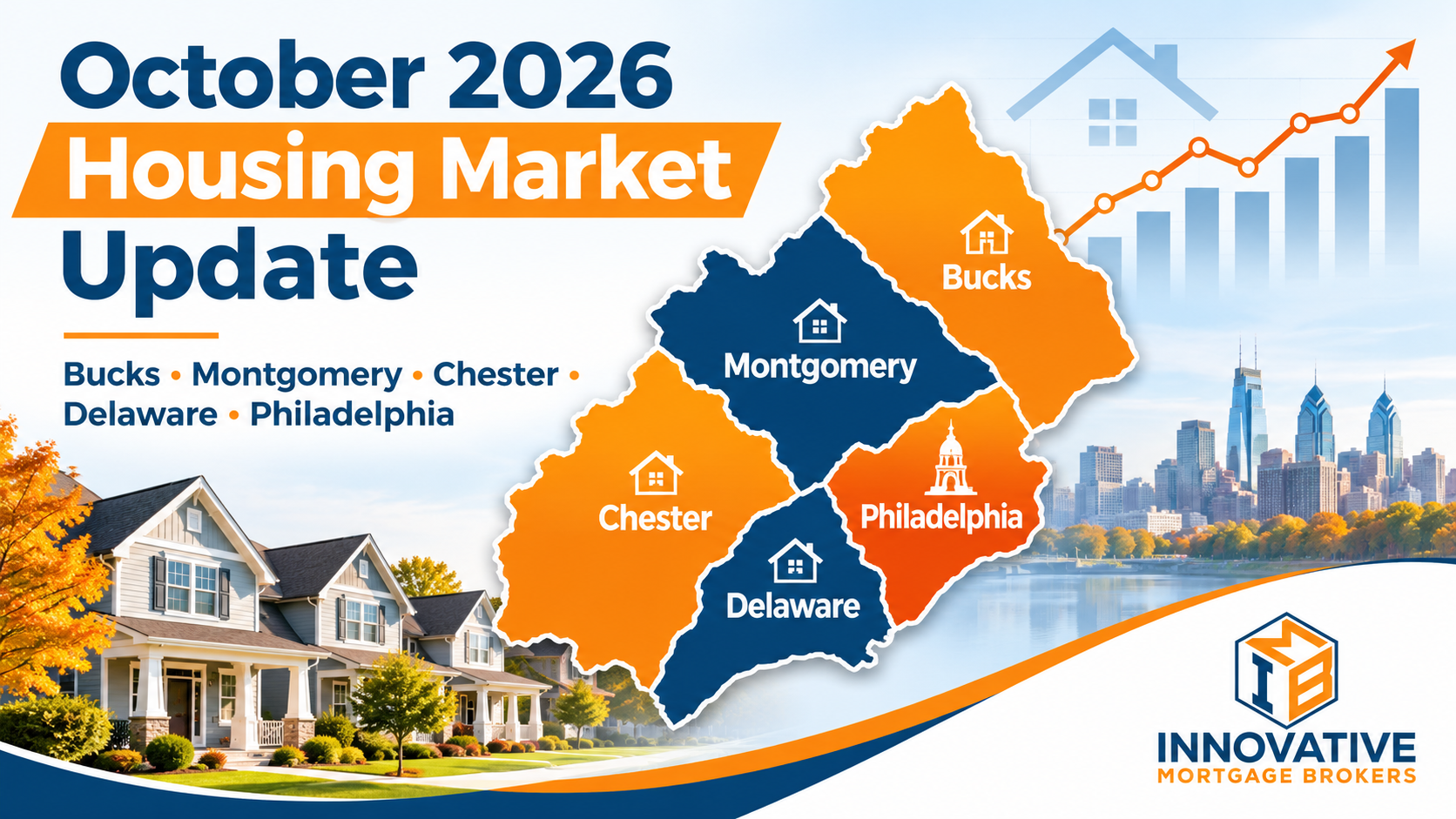
October 2026 Housing Market Update: Bucks, Montgomery, Chester, Delaware, and Philadelphia Counties
If you’ve been waiting for home prices to drop before purchasing a house, the latest housing market numbers might surprise you.
Across Bucks, Montgomery, Chester, Delaware, and Philadelphia counties, something interesting is happening.
There are more homes available for sale. Fewer buyers are signing purchase contracts. Yet home prices are still higher than they were a year ago.
So, what’s going on?
Are we finally seeing a shift toward a buyer’s market? Are sellers losing their advantage? And should buyers continue waiting for prices to come down?
At Innovative Mortgage Brokers, we believe informed homebuyers make better financial decisions. That’s why we’re taking a closer look at the October 2026 housing market reports from Bright MLS to explain what these numbers actually mean for buyers, sellers, and homeowners throughout the Philadelphia region.
October 2026 Housing Market: The Numbers at a Glance
Before diving into the details, here’s how the five counties compare:
| County | Median Sale Price | Annual Price Change | Inventory Change | Median Days on Market |
| Bucks | $520,000 | +2.0% | +42.8% | 12 |
| Montgomery | $483,500 | +9.5% | +14.4% | 10 |
| Chester | $550,000 | +0.9% | +15.7% | 7 |
| Delaware | $370,000 | +3.6% | +31.3% | 13 |
| Philadelphia | $290,000 | +1.8% | +21.2% | 26 |
Source: Bright MLS, October 2026. Changes reflect year-over-year comparisons with October 2025. Inventory change represents active listings.
One thing becomes clear immediately: The housing market isn’t moving in the same direction everywhere, but home prices remain resilient throughout the region.
Let’s take a closer look.
Home Prices Are Still Rising Across All Five Counties
One of the biggest questions homebuyers continue asking is whether home prices are finally coming down.
Based on October’s year-over-year data, the answer is no, at least not across these five counties as a whole.
Every county in our comparison reported a higher median sale price than in October 2025.
Montgomery County experienced the largest increase at 9.5%, bringing its median sale price to $483,500.
That’s $42,000 higher than October 2025, when the median was $441,500.
Bucks County’s median sale price increased 2.0% to $520,000, while Chester County reached $550,000, a 0.9% increase.
Meanwhile, Delaware County recorded a 3.6% increase to $370,000, and Philadelphia rose 1.8% to $290,000.
Now, this doesn’t mean every individual property increased in value by the same percentage.
Median prices can fluctuate depending on which homes sell in a particular month, including their size, location, and price range.
However, the numbers don’t support the idea that home prices are experiencing widespread declines across the Philadelphia region.
What does this mean for buyers?
Waiting for prices to drop may not necessarily result in a better deal.
No one can predict exactly where home prices will go next. However, buyers who are financially ready may benefit from evaluating current opportunities rather than basing their decisions entirely on an anticipated market correction.
Bucks County Housing Inventory Jumps Nearly 43%
Here’s one of the most interesting findings in the October reports.
Bucks County experienced a substantial increase in available homes.
At the end of October 2026, there were 1,165 active listings, compared with just 816 in October 2025.
That’s a 42.8% increase in inventory.
And Bucks County wasn’t alone.
Active listings increased across all five counties:
- Bucks County: +42.8%
- Delaware County: +31.3%
- Philadelphia County: +21.2%
- Chester County: +15.7%
- Montgomery County: +14.4%
For buyers who have spent the past several years competing over a limited number of homes, this is encouraging news.
More inventory generally means more properties to consider, potentially less competition, and additional opportunities to negotiate.
But there’s an important distinction.
More inventory doesn’t automatically mean we’re in a buyer’s market.
Despite the increase in available homes, Bucks County still had just 2.3 months of housing supply in October.
Montgomery County had 2.1 months, while Chester County had 2.2 months.
These figures indicate that inventory remains relatively limited compared with what is typically considered a balanced housing market.
So, while buyers may have more choices than they did a year ago, desirable homes can still attract significant interest.
Fewer Buyers Are Signing Purchase Contracts
While inventory has increased, new purchase contracts have moved in the opposite direction.
Compared with October 2025, new purchase contracts declined across all five counties:
- Bucks County: Down 21.4%
- Delaware County: Down 16.1%
- Philadelphia County: Down 11.0%
- Chester County: Down 7.8%
- Montgomery County: Down 7.0%
Bucks County experienced the largest decline.
Only 514 homes went under contract in October 2026, compared with 654 during the same month last year.
That’s 140 fewer purchase contracts.
What does this tell us?
Buyers appear to be more selective, while some potential purchasers may be postponing their homebuying plans.
Affordability is likely one factor influencing these decisions.
Between home prices, mortgage rates, property taxes, insurance, and other expenses, purchasing a home remains a significant financial commitment.
However, here’s what makes the current market particularly interesting.
Even with fewer buyers signing contracts, median home prices are still higher than they were a year ago.
The slowdown in buyer activity hasn’t translated into widespread countywide price declines.
For prepared buyers, that could create opportunities.
A property that might have attracted several offers previously may now receive fewer.
Depending on the specific property and market conditions, buyers may have additional room to negotiate the purchase price, request seller assistance toward closing costs, or include contingencies in their offers.
Of course, every property is different, and not every seller will be willing to negotiate.
Homes Are Still Selling Surprisingly Fast
With more homes available and fewer buyers signing contracts, you might expect properties to sit on the market significantly longer.
That’s not necessarily happening.
In October 2026, the median time on market was:
| County | Median Days on Market |
| Chester | 7 days |
| Montgomery | 10 days |
| Bucks | 12 days |
| Delaware | 13 days |
| Philadelphia | 26 days |
Chester County stands out.
Despite a 15.7% increase in active listings, homes spent a median of just seven days on the market, compared with nine days a year earlier.
Montgomery County homes sold after a median of 10 days on the market, unchanged from October 2025.
Philadelphia, on the other hand, experienced a longer selling period, with the median increasing from 22 to 26 days.
The takeaway? The market may be slowing overall, but desirable, appropriately priced homes can still sell quickly.
This is one reason mortgage pre-approval remains so important.
Buyers who find the right home shouldn’t have to begin the mortgage qualification process from scratch.
At Innovative Mortgage Brokers, we emphasize reviewing income, assets, credit, and other financial documentation upfront whenever possible.
A well-prepared buyer can often move more confidently when the right property becomes available.
Are Sellers Finally Negotiating More?
Another important statistic in the October housing reports is the average sale-to-original-list-price ratio.
This measures how the final selling price compares with the property’s original asking price.
Here’s how the counties performed:
- Chester County: 100.1%
- Montgomery County: 98.7%
- Bucks County: 98.4%
- Delaware County: 97.5%
- Philadelphia County: 95.0%
Chester County remains particularly competitive, with homes selling for slightly more than their original asking prices on average.
Philadelphia tells a different story.
Homes there sold for an average of 95% of their original asking prices.
That suggests buyers may have more negotiating opportunities in Philadelphia than in certain surrounding suburban markets.
However, averages don’t tell the entire story.
Some homes sell above asking price, while others require price reductions or additional negotiation.
The condition, location, asking price, and demand for a particular property all matter.
It’s also worth remembering that these figures compare selling prices with the original asking prices, not necessarily the final listing prices.
For buyers, the message is simple: Don’t automatically assume the asking price is the final price, but don’t assume every seller is desperate to negotiate either.
An experienced real estate agent can help evaluate comparable sales, local demand, and an appropriate offer strategy.
Philadelphia’s Housing Market Looks Very Different From the Suburbs
One of the most important lessons from this report is that real estate is local.
Even neighboring counties can have dramatically different housing market conditions.
Consider Philadelphia and Chester counties.
In Chester County, homes spent a median of just seven days on the market and sold for an average of 100.1% of their original asking prices.
In Philadelphia, homes spent a median of 26 days on the market and sold for an average of 95% of their original asking prices.
There’s also a substantial difference in available housing supply.
Philadelphia had 5.3 months of inventory, while the surrounding suburban counties had approximately 2.1 to 2.3 months.
That suggests Philadelphia buyers may have greater negotiating leverage and more available choices than buyers in certain suburban markets.
Meanwhile, in popular Bucks County communities such as Doylestown, Newtown, Yardley, and Langhorne, demand for well-priced homes may still be strong.
The same applies to desirable areas throughout Montgomery and Chester counties.
Countywide figures are useful, but they don’t replace understanding what’s happening in a specific neighborhood or price range.
A buyer’s market in one neighborhood can exist alongside a competitive seller’s market just a few miles away.
What Does This Mean for First-Time Homebuyers?
For first-time buyers, the increase in housing inventory offers some encouraging possibilities.
More homes on the market can mean more choices, additional time to evaluate properties, and potentially more opportunities to negotiate.
However, affordability remains an important consideration.
This is where understanding mortgage financing options becomes especially valuable.
Many potential buyers still believe purchasing a home requires a 20% down payment.
Fortunately, that isn’t the case.
Depending on eligibility and the loan program:
- Conventional mortgages may allow down payments as low as 3%.
- FHA loans may allow qualified borrowers to purchase with 3.5% down.
- VA loans may offer eligible borrowers financing without a down payment.
Additional mortgage programs may also be available based on the borrower’s income, credit, assets, and property type.
Of course, a smaller down payment can affect the mortgage balance, monthly payment, and mortgage insurance requirements.
That’s why comparing loan programs is important.
At Innovative Mortgage Brokers, we work with more than 30 wholesale lenders, allowing us to explore different mortgage options rather than relying on a single lender’s programs.
The goal is to help buyers understand their financing choices and select a mortgage that aligns with their financial circumstances.
Planning to Sell Your Home and Buy Another?
For existing homeowners considering a move, the October housing market presents a different set of considerations.
Home prices remain relatively strong throughout the region, but buyers have more choices and appear to be increasingly selective.
That means proper pricing and marketing are particularly important for sellers.
However, homeowners planning to purchase another property also need to think about financing.
For example:
Can you purchase your next home before selling your current property?
Depending on your income, assets, debts, and mortgage program, qualifying while carrying two properties may be possible.
Could you keep your current home as a rental property?
Some mortgage programs may allow eligible rental income to help borrowers qualify, subject to applicable underwriting requirements.
Can you use equity from your current home toward your next purchase?
Depending on the circumstances, options such as a home equity line of credit or other financing strategies may be worth exploring.
Planning ahead can help homeowners avoid unnecessary complications when transitioning from one property to another.
That’s why reviewing mortgage options before listing a home or submitting an offer on another property can be beneficial.
Should You Buy Now or Wait Until 2027?
With more inventory becoming available and buyer activity slowing, some prospective homeowners are wondering whether they should wait until 2027 to purchase.
It’s a reasonable question.
However, the October 2026 data doesn’t indicate a widespread housing market crash across these five counties.
While inventory is increasing and purchase contracts are declining, median prices remain higher than they were last year.
And in several counties, homes continue to sell relatively quickly.
Could prices decline in the future? Certainly.
Could mortgage rates change and affect affordability? Absolutely.
But accurately predicting both future mortgage rates and home prices is extremely difficult.
Rather than trying to perfectly time the market, buyers may benefit from focusing on several practical questions:
- Can you comfortably afford the monthly payment? Mortgage qualification and personal affordability aren’t necessarily the same thing.
- Does the property meet your current and future needs? Consider your lifestyle, financial goals, and how long you expect to own the home.
- Have you compared your mortgage options? Different lenders and loan programs may offer different rates, fees, and qualification requirements.
- Are you financially prepared for homeownership? Consider your down payment, closing costs, emergency savings, maintenance, taxes, and insurance.
If the numbers work and the property meets your needs, purchasing may make sense.
If they don’t, continuing to save and prepare may be the smarter decision.
There’s no universal answer that applies to every buyer.
The Bottom Line: The Philadelphia Housing Market Is Changing, but It’s Not Crashing
The October 2026 housing data reveals several important trends throughout Bucks, Montgomery, Chester, Delaware, and Philadelphia counties.
Inventory is increasing. Buyer activity is slowing. Some sellers may be facing greater competition. But home prices are still higher than they were a year ago.
The housing market appears to be shifting, but not uniformly.
Some areas remain highly competitive, while others may offer buyers greater negotiating power.
For buyers, this means more opportunities may be emerging, but being financially prepared remains important.
For sellers, realistic pricing and understanding local market conditions are becoming increasingly valuable.
For homeowners considering their next move, reviewing available financing strategies before making major decisions can help avoid unnecessary surprises.
At Innovative Mortgage Brokers, our goal is to help borrowers understand their financing options and make informed decisions, whether they’re purchasing their first home, moving to a larger property, refinancing, or investing in real estate.
Explore Your Mortgage Options With Innovative Mortgage Brokers
Buying a home involves more than finding the right property.
It also means understanding your budget, choosing an appropriate mortgage program, comparing interest rates and closing costs, and making sure your financing is properly structured.
Innovative Mortgage Brokers helps homebuyers and homeowners throughout Pennsylvania and Florida explore financing solutions from more than 30 wholesale lenders.
We offer access to conventional, FHA, VA, jumbo, renovation, investment property, and various Non-QM mortgage programs.
Whether you’re just beginning your home search or already considering a property, our team can help you understand your financing options and develop a plan for your next move.
Our goal is simple: Make the mortgage process faster, easier, and more affordable while providing the communication and guidance borrowers deserve.

Related Posts