
One of the most common questions homebuyers and homeowners ask is: “What are mortgage rates…
FHA vs. Conventional Loans: What Is the Difference?
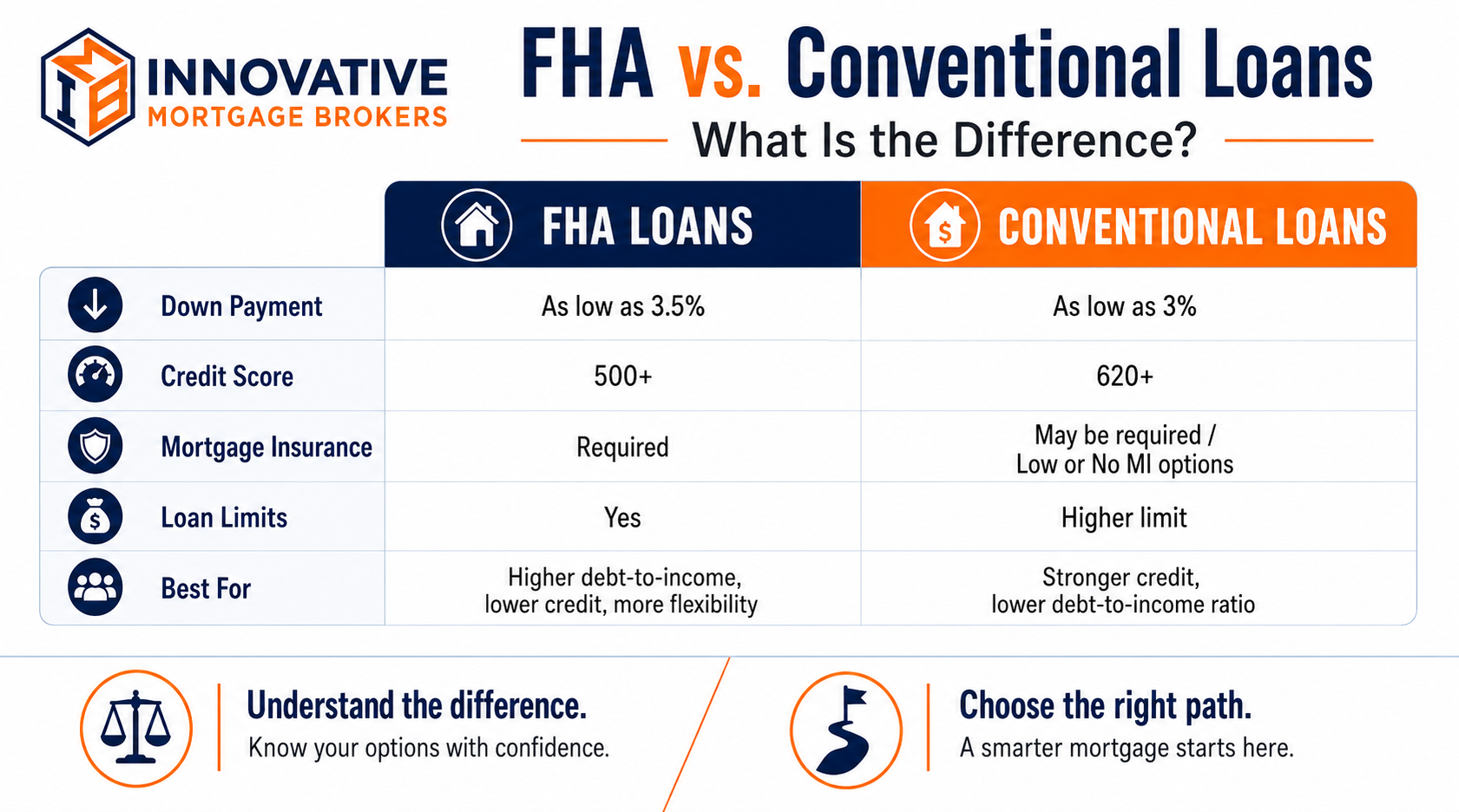
When buying a home, two of the most common mortgage options are FHA loans and conventional loans. Both can be excellent choices. The mistake is assuming one is automatically better than the other.
The right mortgage depends on your credit, down payment, monthly payment, mortgage insurance, property type, and long-term plans. In some situations, FHA financing may provide a significant advantage. In others, a conventional loan may cost less over time.
At Innovative Mortgage Brokers, we regularly compare both options because the loan with the lower interest rate is not necessarily the loan with the lower overall cost.
Here is how FHA and conventional mortgages differ and how to decide which one may make more sense for you.
FHA vs. Conventional Loans at a Glance
|
Feature |
FHA Loan |
Conventional Loan |
| Government insured | Yes, by FHA | No |
| Minimum down payment | As little as 3.5% | Some programs allow 3% |
| Credit flexibility | Generally more flexible | Generally stronger credit is beneficial |
| Mortgage insurance | Required on most FHA loans | Usually required with less than 20% down |
| Can mortgage insurance be removed? | Depends on original LTV and loan terms | PMI may generally be canceled after sufficient equity is reached |
| Primary residence | Yes | Yes |
| Second home | No | Potentially |
| Investment property | No | Potentially |
| Loan limits | FHA county limits apply | Conforming limits apply to conforming conventional loans |
| Property standards | FHA requirements apply | Conventional requirements generally differ |
| Best fit | Often attractive for borrowers with lower credit or limited down payment | Often attractive for borrowers with stronger credit or more equity |
These are general guidelines. Actual eligibility depends on underwriting, the specific loan program, and lender requirements.
What Is an FHA Loan?
An FHA loan is a mortgage made by an FHA-approved private lender and insured by the Federal Housing Administration, which is part of the U.S. Department of Housing and Urban Development.
The federal government is not lending you the money. Instead, FHA insurance protects the lender against certain losses if the borrower defaults.
Because of that insurance, lenders may be able to approve borrowers who would have a harder time qualifying for certain conventional programs.
FHA loans allow down payments as low as 3.5% and generally accommodate lower credit scores more readily than conventional financing.
Learn more about FHA loan options from Innovative Mortgage Brokers.
What Is a Conventional Loan?
A conventional mortgage is simply a mortgage that is not insured or guaranteed by a federal government program such as FHA, VA, or USDA.
Many conventional mortgages are conforming loans that follow guidelines established by Fannie Mae or Freddie Mac.
Conventional financing is not limited to buyers making large down payments. Eligible conventional programs can allow financing up to 97% of the home’s value, meaning a down payment as low as 3% in certain situations.
Learn more about conventional mortgage options.
FHA and Conventional Loans Have Different Down Payment Requirements
One of the biggest misconceptions is that FHA is always the lowest-down-payment mortgage.
It is not.
FHA
An eligible borrower can generally purchase with as little as:
3.5% down
Conventional
Certain conventional programs allow:
3% down
Fannie Mae offers eligible 97% loan-to-value financing, while programs such as HomeReady also provide financing with as little as 3% down. Freddie Mac’s HomeOne program likewise offers 3% down for qualified first-time buyers.
So a first-time homebuyer should not automatically assume FHA requires less money.
Example
On a $400,000 purchase:
3.5% FHA down payment:
$14,000
3% conventional down payment:
$12,000
That is a $2,000 difference in the initial down payment.
But down payment alone does not tell you which loan is better. Mortgage insurance, rate, closing costs, and qualification also need to be compared.
FHA Is Generally More Forgiving of Credit Challenges
This is one of FHA’s biggest strengths.
FHA financing was designed in part to expand access to mortgage credit. FHA permits lower credit scores than many conventional mortgage options, although individual lenders can impose their own stricter requirements.
Conventional underwriting tends to reward stronger credit more heavily.
That does not mean you must have perfect credit to qualify for conventional financing.
In fact, Fannie Mae’s current Desktop Underwriter does not impose a universal minimum credit score on every DU-approved casefile. Manually underwritten fixed-rate Fannie Mae loans generally have a 620 minimum, subject to applicable guidelines and exceptions.
The bigger practical difference is often pricing.
As credit scores decline, conventional mortgage pricing and PMI can become more expensive. FHA pricing may sometimes remain comparatively attractive.
That means a borrower with a 660 score, for example, could potentially qualify for both programs but find that FHA produces a more attractive monthly payment.
A borrower with a 760 score might experience the opposite.
This is exactly why it is better to compare actual scenarios instead of assuming that one program is always cheaper.
Mortgage Insurance Works Very Differently
This may be the most important financial difference between FHA and conventional financing.
FHA Mortgage Insurance
Most FHA mortgages include two forms of mortgage insurance:
Upfront Mortgage Insurance Premium, or UFMIP
For most FHA purchase loans, the upfront premium is currently 1.75% of the base loan amount. It is commonly financed into the mortgage rather than paid entirely in cash at closing.
Annual Mortgage Insurance Premium, or MIP
The annual FHA mortgage insurance premium is generally collected through monthly mortgage payments. The exact premium depends on factors such as the loan term, loan amount, and loan-to-value ratio.
Conventional PMI
Conventional mortgages generally require private mortgage insurance when the borrower makes a down payment of less than 20%.
Unlike FHA MIP, conventional PMI pricing can vary substantially based on:
- Credit score
- Down payment
- Loan amount
- Property type
- Number of borrowers
- Mortgage insurance provider
This creates an important distinction.
A borrower with excellent credit may receive relatively inexpensive conventional PMI.
Someone with weaker credit may find conventional PMI significantly more expensive.
Conventional PMI May Be Easier to Eliminate
This is one of the biggest potential long-term advantages of a conventional loan.
For many conventional mortgages, borrowers can request cancellation of PMI when the principal balance reaches 80% of the home’s original value, assuming applicable requirements are satisfied. PMI generally must terminate automatically when the scheduled principal balance reaches 78%, provided the loan is current.
FHA mortgage insurance works differently.
Depending on the original loan-to-value ratio and loan terms, FHA mortgage insurance may remain for a much longer period and, for many low-down-payment FHA loans, cannot simply be canceled once the homeowner reaches 20% equity.
In that situation, removing FHA mortgage insurance may eventually require refinancing into another mortgage, assuming refinancing makes financial sense at that time.
This difference can make conventional financing more attractive for borrowers who expect to own the home for many years.
FHA May Be More Flexible With Certain Borrower Profiles
Mortgage approval is not based on one number.
Underwriting considers the entire financial picture, including:
- Credit history
- Income
- Employment
- Monthly debts
- Assets
- Down payment
- Payment history
- Property
- Overall risk
FHA may sometimes provide more flexibility for borrowers who have:
- Lower credit scores
- Limited savings
- Previous credit challenges
- Higher debt-to-income ratios
- Smaller down payments
That does not mean FHA automatically approves a borrower with high debt or poor credit.
An FHA loan still has to satisfy FHA underwriting requirements, and individual lenders may impose additional requirements.
Conventional automated underwriting also evaluates numerous risk factors together rather than making decisions based solely on one credit score or DTI number.
Conventional Loans Can Be Used for More Property Types
FHA financing is generally designed for a borrower’s primary residence.
At least one FHA borrower generally must occupy the property as a principal residence within the required timeframe and intend to continue occupying it as a principal residence.
Conventional financing can potentially be used for:
- Primary residences
- Second homes
- Investment properties
Fannie Mae’s guidelines specifically recognize all three occupancy types.
So if you are purchasing a vacation home or a property you intend to use entirely as a rental, conventional financing may be an option while standard FHA financing generally would not be.
What About a Multifamily Property?
FHA financing can potentially be used to buy an eligible two-to-four-unit property as long as the borrower meets the occupancy requirements.
That means you could potentially purchase a duplex, triplex, or four-unit property with FHA financing, live in one unit, and rent the others.
This can make FHA particularly interesting for buyers considering a house-hacking strategy.
FHA Properties Have Additional Requirements
Another difference involves the property itself.
An FHA appraisal is not simply about determining market value. FHA-financed properties must also comply with applicable FHA property requirements.
HUD maintains property standards intended to address issues involving the property and the government’s collateral risk.
Potential concerns can include certain safety, structural, or condition issues.
That does not mean an FHA-financed house needs to be perfect.
A common misconception is that FHA will reject any house needing repairs. Minor cosmetic issues generally do not automatically make a property unsuitable for FHA financing.
However, certain significant conditions may need to be corrected before the mortgage can close.
Conventional appraisals also evaluate the property, but the requirements are not identical to FHA’s.
FHA and Conventional Loan Limits Are Different
Both programs can have loan limits, but the limits are established differently.
FHA loan limits vary by location and property size.
For 2026, FHA’s one-unit loan limit ranges from a $541,287 floor in lower-cost areas up to a $1,249,125 ceiling in high-cost areas. Individual county limits determine what applies to a particular property.
Conforming conventional mortgages have their own limits established through the federal housing finance system.
This becomes especially important when purchasing a higher-priced property.
Depending on the property location and loan amount, one program may accommodate the transaction while another does not.
FHA Does Not Automatically Have a Lower Rate
You may sometimes see FHA mortgage rates advertised below conventional mortgage rates.
That does not necessarily mean FHA is cheaper.
Why?
Because the mortgage rate is only one piece of the loan.
You also have to consider:
- FHA upfront mortgage insurance
- Monthly FHA mortgage insurance
- Conventional PMI
- Discount points
- Lender fees
- Loan-level pricing
- Down payment
- How long you plan to own the home
The CFPB specifically notes that FHA may be less expensive for some borrowers with lower credit scores or smaller down payments, while borrowers with stronger credit and larger down payments may find conventional loans less expensive.
This is why I would never recommend choosing FHA or conventional solely because one has a rate that is 0.125% or 0.25% lower.
Compare the total monthly payment and overall cost.
FHA vs. Conventional Example
Consider two buyers purchasing the exact same home.
Buyer A
- 655 credit score
- 3.5% available for down payment
- Limited reserves
- Some previous credit issues
FHA may potentially provide the stronger combination of approval flexibility, pricing, and monthly payment.
Buyer B
- 760 credit score
- 10% down payment
- Strong reserves
- Stable income
Conventional financing may potentially provide lower mortgage insurance costs and an easier path toward eventually eliminating mortgage insurance.
Neither borrower should choose a program based solely on the examples above.
Actual pricing can change daily, and underwriting depends on the entire file.
Is FHA Only for First-Time Homebuyers?
No.
This is one of the most common FHA myths.
You do not have to be a first-time homebuyer to obtain an FHA mortgage.
A repeat buyer may use FHA financing as long as the transaction satisfies FHA eligibility and occupancy requirements.
Similarly, conventional low-down-payment programs are not exclusively for first-time buyers. For example, Fannie Mae’s HomeReady program does not require all borrowers to be first-time homebuyers, although income and other eligibility requirements apply.
Is Conventional Always Better if You Have Good Credit?
Not necessarily.
Strong credit can make conventional financing extremely attractive, particularly because PMI may be inexpensive and eventually removable.
But that does not mean conventional automatically wins.
FHA could still make sense because of:
- Interest-rate differences
- Debt-to-income considerations
- Gift funds
- Qualification differences
- Other characteristics of the borrower or transaction
The only reliable answer is to run both scenarios.
Is FHA Better if Your Credit Score Is Lower?
Often, but not always.
FHA tends to become more competitive as credit scores decline because FHA’s insurance structure can reduce some of the lender’s risk.
The CFPB notes that FHA loans can often be less expensive than conventional loans for borrowers with lower credit scores or smaller down payments.
However, the complete mortgage needs to be compared.
Sometimes conventional still produces the stronger result.
Should You Put 20% Down to Avoid Mortgage Insurance?
Not automatically.
Avoiding mortgage insurance sounds appealing, but using an extra $40,000 or $60,000 for a down payment may not always be the right financial strategy.
That money could potentially be needed for:
- Emergency reserves
- Renovations
- Moving expenses
- Investments
- Furniture
- Future repairs
- Other financial goals
PMI is simply one component of the mortgage.
The better question is:
What combination of down payment, monthly payment, and cash remaining after closing puts you in the strongest financial position?
FHA or Conventional: Which One Should You Choose?
There is no universal winner.
FHA may make more sense when:
Your credit is less established or has some challenges.
You have a limited down payment.
Conventional PMI or conventional pricing is expensive.
FHA underwriting provides a stronger approval path.
Conventional may make more sense when:
You have stronger credit.
You want the possibility of eliminating PMI later.
You are making a larger down payment.
You are purchasing a second home or investment property.
Conventional pricing produces a lower overall cost.
The important part is actually comparing them.
Compare FHA and Conventional Side by Side
When we review a mortgage, we are not trying to force the borrower into a particular program.
At Innovative Mortgage Brokers, we can compare different lenders and financing structures to determine which combination may make the most sense based on your situation.
For a borrower who qualifies for both FHA and conventional financing, we can compare:
Monthly payment
Cash needed at closing
Interest rate
Mortgage insurance
Closing costs
Long-term cost
Qualification requirements
Sometimes FHA wins.
Sometimes conventional wins.
And sometimes the answer changes depending on whether your priority is keeping more cash in the bank, reducing your monthly payment, or minimizing long-term costs.
That is why mortgage strategy matters.
Frequently Asked Questions About FHA vs. Conventional Loans
Is FHA better than conventional?
Neither is automatically better. FHA can be particularly attractive for borrowers with lower credit scores or smaller down payments, while conventional financing may be more cost-effective for borrowers with stronger credit. The right choice depends on the entire loan scenario.
Which requires a smaller down payment?
Some conventional programs allow as little as 3% down, while FHA generally allows a minimum down payment of 3.5% for eligible borrowers.
Which is easier to qualify for?
FHA guidelines generally provide more flexibility for borrowers with lower credit scores, although approval is never guaranteed and lenders may have additional requirements.
Does FHA mortgage insurance go away?
It depends on the original loan-to-value ratio and applicable FHA rules. For many FHA borrowers making the minimum down payment, mortgage insurance does not automatically disappear simply because the homeowner later reaches 20% equity.
Can conventional PMI go away?
For many conventional mortgages, yes. Borrowers generally have rights to request PMI cancellation at 80% of the home’s original value when applicable conditions are met, and automatic termination generally occurs at the scheduled 78% level when the borrower is current.
Can I switch from FHA to conventional later?
Potentially. An FHA homeowner may later refinance into a conventional mortgage if they qualify and the refinance makes financial sense. Refinancing involves a new loan, new qualification, and typically closing costs, so it should be evaluated carefully.
Can I buy an investment property with FHA?
FHA financing is generally intended for principal residences, not properties purchased solely for investment. Conventional financing can potentially be used for investment properties.
Find Out Which Mortgage Makes More Sense for You
Choosing between FHA and conventional financing should not be based on a rule of thumb.
It should be based on your numbers.
Your credit, income, down payment, property, monthly debts, available assets, and long-term plans can all change the answer.
At Innovative Mortgage Brokers, we can compare multiple lenders and mortgage programs to help determine whether FHA, conventional, or another financing option makes more sense for your situation.
Schedule a mortgage consultation or call 215-309-1757 to review your options.

Related Posts